cd /usr/ports/databases/phpmyadmin
make install clean
cp -r /usr/local/www/phpMyAdmin /usr/local/www/apache22/data/phpmyadmin
cd /usr/local/www/apache22/data/phpmyadmin
cp config.sample.inc.php config.inc.php
chmod 644 config.inc.php
cd /usr/ports/databases/phpmyadmin
make install clean
cp -r /usr/local/www/phpMyAdmin /usr/local/www/apache22/data/phpmyadmin
cd /usr/local/www/apache22/data/phpmyadmin
cp config.sample.inc.php config.inc.php
chmod 644 config.inc.php
php配置文件php.ini中默认设置允许上传的最大文件数据为2M,因此通过phpmyadmin Web界面管理mysql数据库时,能够导入mysql数据库的最大sql文件或gzip文件大小也是2M (2048K)。如果要导入大于2M的sql数据库文件,有以下几种解决方法。
最直接的解决办法当然就是修改php.ini配置文件的设置,即修改默认的 upload_max_filesize = 2M, memory_limit = 128M; post_max_size = 8M 。 比如我想上传一个27M的sql数据库文件,则可以修改为 upload_max_filesize = 32M, post_max_size = 32M,post_max_size 和 memory_limit 的值至少要大于等于upload_max_filesize的设置值。增加了php.ini中的最大上传设置数据之后,重启Apache数据库,再打开phpmyadmin 就可以上传大的sql数据库文件等等。
另外一种方法适用于没有权限修改网站服务器php.ini文件设置的用户,可以使用phpmyadmin提供的$cfg[‘UploadDir’]方法,$cfg[‘UploadDir’]方法允许我们通过scp、ftp等文件传输方式上传数据库文件到网站服务器,然后phpmyadmin从服务器的临时目录中导入数据库文件。该上传的文件名后缀必须为.sql或者.sql.bz2 或.sql.gz 。具体步骤如下:
在phpMyAdmin的根目录下找到config.inc.php文件(config.sample.inc.php),打开找到$cfg[‘UploadDir’] 和$cfg[‘SaveDir’],注释为“Directories for saving/loading files from server ”,即通过$cfg[‘UploadDir’] 和$cfg[‘SaveDir’]可以导入服务器上的SQL文件到数据库,以及将从数据库导出的SQL文件保存到服务器上的目录中。
修改这个参数为$cfg[‘UploadDir’] = ‘ImportSQLFile’; 和 $cfg[‘SaveDir’] = ‘ExportSQLFile’;
再在phpMyAdmin中建立两个文件夹,ImportSQLFile和ExportSQLFile。也就是将需要导入的sql文件复制到ImportSQLFile文件夹中,上传到服务器上。选择需要导入的数据库名,选择导入(Import),就会发现在文件导入(File to import)的地方多出来一个导入服务器上的SQL文件(web server upload directory)。通过这种方法可以突破php.ini的上传文件限制。导出/备份mysql数据的时候也可以直接保存在服务器上,保存到$cfg[‘SaveDir’] = ‘ExportSQLFile’; 中指定的文件夹中。
另外,如果网站服务器和国外美国主机dreamhost一样支持Shell方式(SSH,SFTP,命令行)传输文件,那么通过shell方式导入Mysql数据库很大的sql文件都不成问题,直接在Mysql中使用命令:source filename.sql。
如果还是不能上传大于2M的数据库数据文件,可以检查一下你的phpmyadmin 版本是不是最新的,据说phpmyadmin低于 2.7.0版本会出现类似memory内存、http错误和timeout超时等各种问题,因此最好安装phpmyadmin升级到最新版本。
解决方案:
libraries/config.default.php,将$cfg[‘PmaNoRelation_DisableWarning’]的值改为ture。
分别修改:
$cfg[‘Servers’][$i][‘pmadb’] = ”; // ‘phpmyadmin’ – see scripts/create_tables.sql
$cfg[‘Servers’][$i][‘bookmarktable’] = ”; // ‘pma_bookmark’
$cfg[‘Servers’][$i][‘relation’] = ”; // ‘pma_relation’
$cfg[‘Servers’][$i][‘table_info’] = ”; // ‘pma_table_info’
$cfg[‘Servers’][$i][‘table_coords’] = ”; // ‘pma_table_coords’
$cfg[‘Servers’][$i][‘pdf_pages’] = ”; // ‘pma_pdf_pages’
$cfg[‘Servers’][$i][‘column_info’] = ”; // ‘pma_column_info’
$cfg[‘Servers’][$i][‘history’] = ”; // ‘pma_history’
$cfg[‘Servers’][$i][‘designer_coords’] = ”;
修改为:
$cfg[‘Servers’][$i][‘pmadb’] = ‘phpmyadmin’; // ‘phpmyadmin’ – see scripts/create_tables.sql
$cfg[‘Servers’][$i][‘bookmarktable’] = ‘pma_bookmark’; // ‘pma_bookmark’
$cfg[‘Servers’][$i][‘relation’] = ‘pma_relation’; // ‘pma_relation’
$cfg[‘Servers’][$i][‘table_info’] = ‘pma_table_info’; // ‘pma_table_info’
$cfg[‘Servers’][$i][‘table_coords’] = ‘pma_table_coords’; // ‘pma_table_coords’
$cfg[‘Servers’][$i][‘pdf_pages’] = ‘pma_pdf_pages’; // ‘pma_pdf_pages’
$cfg[‘Servers’][$i][‘column_info’] = ‘pma_column_info’; // ‘pma_column_info’
$cfg[‘Servers’][$i][‘history’] = ‘pma_history’; // ‘pma_history’
$cfg[‘Servers’][$i][‘designer_coords’] = ‘pma_designer_coords’;
使用Debian确实是省心又省力,基本你只需要会用aptitude install就可以了,其它的事情,Debian全帮你做好了。在Debian上安装Apache Web服务器以及PHP5和MySQL非常简单,只需要按照下面的步骤:
安装Apache2:
aptitude install apache2
这件命令安装apache服务器,安装完成后,Apache服务器的配置文件在/etc/apache2/,缺省的web服务器根目录在/var/www/,安装完后,你在浏览器的地址栏输入http://localhost/,如果可以看到It works!这样的内容,那么你的web服务器已经运行起来了。
接下来安装PHP5和MySQL5、Curl(HTTP工具)、IMAP(邮件检查)、GD (编辑和创建图像):
aptitude install libapache2-mod-php5 php5-curl php5-gd php5-imap php5-mcrypt php5-mysql php5-tidy
接下来安装MySQL5服务器和客户端:
aptitude install mysql-server mysql-client
MySQL的配置文件在/etc/mysql/my.cnf,在安装MySQL服务器的时候,会要求你输入root密码。
最后,安装PHPMyAdmin工具:
aptitude install phpmyadmin
PHPMyAdmin会自动配置Apache服务器,安装完后,可以直接输入http://localhost/phpmyadmin/来访问PHPMyAdMin。
我们可以查看一下PHP的信息,以确信PHP已经运行起来了:
使用编辑器输入以下内容,把它保存成/var/www/phpinfo.php:
<?php phpinfo(); ?>
然后在浏览器地址栏输入http://localhost/phpinfo.php,你就可以看到PHP有关的配置信息。
1. Introduction:
This article describes how to setup Apache, MySQL, PHP and phpMyAdmin on a server running FreeBSD. The article was written for the software versions below but is likely to work on newer versions without too much difficulty.
2. Software:
Operating System: FreeBSD 7.0 for i386 Download
Apache: 2.2.8 Installed from Ports Collection
MySQL Server: 5.0.51a Installed from Ports Collection
PHP & Extensions: 5.2.5 Installed from Ports Collection
phpMyAdmin: 2.11.5 Installed from Ports Collection
3. Before you begin:
This article assumes you have a working install of FreeBSD 6.2 for i386 logged in as root (or another user in the wheel group and you have used “su”) with the ports collection installed. You can use sysinstall, cvsup or portsnap to install the ports distribution if you have not already done so. See point 2 below.
Update your ports collection (portsnap fetch, portsnap extract.) (See the FreeBSD Handbook Section 4.5.1)
(1) Go to the mysql50-server port directory by typing the command:
cd /usr/ports/databases/mysql50-server
(2) Build the port by typing: (This takes AGES – good time for some food.)
make BUILD_OPTIMIZED=yes BUILD_STATIC=yes
(3) Install by typing:
make install clean
(4)Open /etc/rc.conf with your favourite text editor and add the line shown below. This will ensure mysql is enabled and starts on boot.
mysql_enable=”YES”
(5)Start mysql manually to avoid having to reboot now by typing:
/usr/local/etc/rc.d/mysql-server start
(6)Set a password for the MySQL root user by executing the command, subtituting your own password in place of new-password:
/usr/local/bin/mysqladmin -uroot password ‘new-password’
And you’re done! MySQL is installed.
5.Installing Apache
(1)Go to the apache22 port directory by typing the command:
cd /usr/ports/www/apache22
(2)Build and install the port by typing: (This takes a while, coffee time!)
make install clean
Note: You may want to disable the two DAV options if you don’t need them when prompted
(3)Open /etc/rc.conf with your favourite text editor and add the line shown below. This will ensure apache is enabled and starts on boot.
apache22_enable=”YES”
(1)Go to the php5 port directory by typing the command:
cd /usr/ports/lang/php5
(2)Build and install the port by typing: (Just accept the default options, this takes a while, more coffee.)
make install clean
Make sure the APACHE (Build Apache module) option is ticked when configuring the build, leaving all other options as default, before selecting OK.
(3)Go to the php5-extentions meta port directory by typing the command:
cd /usr/ports/lang/php5-extentions
(4)Build and install the port by typing: (Just accept the defaults here, phpMyAdmin will install any other extensions required itself)
make install clean
(5)Install the php.ini file:
cp /usr/local/etc/php.ini-dist /usr/local/etc/php.ini
版本不同,只面的文件可能有所改变
php.ini-production对应于php.ini-recommended
php.ini-development对应于php.ini-dist
php.ini-development 开发用的,php.ini-produciton 生产机用的,如果做站的话,我觉得应该将php.ini-produciton改为php.ini,用php.ini-produciton可能会出现无法支持PHP,修改php.ini中的短标签开关short_open_tag=Off在作怪,改成On就行了
(6)Edit your Apache configuration file (/usr/local/etc/apache22/httpd.conf) and add the following lines to the end of the file:
AddType application/x-httpd-php .php
AddType application/x-httpd-php-source .phps
Note: You can add additional extenions other than .php (eg .phtml) seperated by spaces.
Note: The second line is optional, it will show colour highlighted PHP source for .phps files.
(7)You should also search for the line that reads:
DirectoryIndex index.html
and change it to read:
DirectoryIndex index.php index.html
Note: You may also add index.phtml or any other default page if you added additional extentions in the previous step.
(8)Enable language settings by searching for the line:
#Include etc/apache22/extra/httpd-languages.conf
and removing the # comment mark so it reads:
Include etc/apache22/extra/httpd-languages.conf
(9)Edit the language settings file (/usr/local/etc/apache22/extra/httpd-languages.conf) and add the following line at the end of the file:
AddDefaultCharset On
(10)Start Apache using the startup script:
/usr/local/etc/rc.d/apache22 start
And you’re done! Apache with PHP is installed.
安装Zend Optimizer
cd /usr/ports/devel/ZendOptimizer/
make install clean
===> ZendOptimizer-3.3.0.a cannot install: doesn’t work with PHP version : 5 (Doesn’t support PHP 5).
*** Error code 1
Stop in /usr/ports/devel/ZendOptimizer.
注:如果你用的是FreeBsd8.0版本的可能会出现上面的情况,这里可以使用使用pkg_add命令来安装Zend Optimizer.
#pkg_add -r ZendOptimizer
#rehash
执行结果将类似如下:
Fetching ftp://ftp.freebsd.org/pub/FreeBSD/ports/i386/packages-8.0-release/Latest/ZendOptimizer.tbz… Done.
pkg_add: warning: package ‘ZendOptimizer-3.3.0.a’ requires ‘libxml2-2.7.5’, but ‘libxml2-2.7.7’ is installed
pkg_add: warning: package ‘ZendOptimizer-3.3.0.a’ requires ‘php5-5.2.11’, but ‘php5-5.3.2’ is installed
********************************************************************************
You have installed the ZendOptimizer package.
Edit /usr/local/etc/php.ini and add:
[Zend]
zend_optimizer.optimization_level=15
zend_extension_manager.optimizer=”/usr/local/lib/php/20060613/Optimizer”
zend_extension_manager.optimizer_ts=”/usr/local/lib/php/20060613/Optimizer_TS”
zend_extension=”/usr/local/lib/php/20060613/ZendExtensionManager.so”
zend_extension_ts=”/usr/local/lib/php/20060613/ZendExtensionManager_TS.so”
NOTE: PHP should be compiled in non-debug mode (default).
********************************************************************************
虽然居然成功了,但也可能用phpinfo时候还是不行的![可惜最后还是不行,得到的教训是,不要用太新的版本,这样资料和环境的支持会很不完善。]
7.Installing phpMyAdmin
(1)Got to the phpmyadmin port directory by typing the command:
cd /usr/ports/databases/phpmyadmin
(2)Build and install the port by typing: (Just accept the default options)
make install clean
(3)phpMyAdmin is now installed in /usr/local/www/phpMyAdmin. To use it we need to create Alias and Directory entries in /usr/local/etc/apache22/httpd.conf. To do this, add the following lines to the <IfModule alias_module> section (just search for where all the other Alias commands are.)
Alias /phpmyadmin /usr/local/www/phpMyAdmin
(4)As /usr/local/www/phpMyadmin is outside of the Apache <DocumentRoot> you will have to make a <Directory> entry for it too. Add the following lines to the end of the <Directory> section: (just search for </Directory>)
<Directory “/usr/local/www/phpMyAdmin”>
Order allow,deny
Allow from all
</Directory>
Note:You may prefer to put the Alias entry inside a <VirtualHost> entry if you are hosting multiple sites using name based virtual hosting and do not wish to enable phpMyAdmin on all the sites.
(5)Create a config directory for phpMyAdmin and make it globally read/write/executable by typing the commands:
cd /usr/local/www/phpMyAdmin
mkdir config
chmod 777 config
(6)Restart Apache so that the Alias and Directory entries take effect by typing:
/usr/local/etc/rc.d/apache22 restart
(7)Configure phpMyAdmin by going to http://hostname/phpmyadmin/scripts/setup.php in your browser and set at least the following:
Save the configuration using the Save button in the Configuration section.
(8)For the changes to take effect you must copy the generated config file from the phpMyAdmin/config directory to the phpMyAdmin directory by typing the following command: (Note the space dot at the end of the command)
cp config/config.inc.php .
(9)You can now delete the config directory you created earlier and reset the permissions on the config.inc.php file to read only typing the commands:
rm -rf config
chmod 444 config.inc.php
(10)That’s it! You can place your web site in /usr/local/www/data/ and access phpMyAdmin at http://hostname/phpmyadmin/ in your web browser and logging in using username root and the MySQL password you set earlier.
以上安装完,可能有所出入,特别是Apache22可能无法启动,以下两点是一些总结:
1:注意:apache22有个bug,不能启动FreeBSD自带的一个基于http端口过滤的模块。这个模块的作用很不错——检查HTTP请求是否完整,符合规则accpt一个Http进程,否则就扔掉。你会遇到如下提示
[Sat Jan 23 22:47:29 2010] [warn] (2)No such file or directory: Failed to enable the ‘httpready’ Accept Filter 解决方法是:
#kldload accf_http 或者将/boot/defaults/loader.conf==> accf_httpd_load=”YES”
2.apache22无法启动时,进入/var/logo查看httpd_error.log, 如果出现以下提示:
[alert] (EAI 8)hostname nor servname provided, or not known: mod_unique_id: unable to find IPv4 address of “shao Configuration Failed
解决方法:进入/usr/local/etc/apache22 ee ./httpd.conf
将LoadModule unique_id_module libexec/apache2/mod_unique_id.so注释掉
然后启动/usr/local/etc/rc.d/apache22 start即可.
一个IP多个域名添加方法
在httpd.conf中去掉httpd-vhosts.conf那一栏注释,然后进入/usr/local/etc/apache22/extra/修改httpd-vhosts.conf网站域名对应的目录,还要加
<Directory “/usr/home/www/jpeps.com”>
Options FollowSymLinks
AllowOverride None
Order allow,deny
Allow from all
</Directory>
<IfModule dir_module>
DirectoryIndex index.html index.htm index.php
</IfModule>
添加php.ini 被禁用的函数(disable_functions)
passthru,exec,system,chroot,scandir,chgrp,chown,shell_exec,proc_open,proc_get_status,ini_alter,ini_restore,dl,pfsockopen,openlog,syslog,readlink,symlink,popepassthru,stream_socket_server,fsocket,fsockopen
第一种方式: portsnap (自带)
首先修改/etc/portsnap.conf
SERVERNAME=portsnap.cn.freebsd.org
1.下载压缩的 Ports 套件快照到 /var/db/portsnap
# portsnap fetch
2.假如是首次运行 Portsnap, 则需要将快照释放到 /usr/ports:
# portsnap extract
如果您已经有装好的 /usr/ports 而只想更新, 则应执行下面的命令:
# portsnap update
完成后需要退出终端重新登陆。
复制cvsup更新配置文件
# cp /usr/share/examples/cvsup/ports-supfile /etc/supfile
下面是我使用的配置,屏蔽了desktop等一些服务器用不到的软件包,源已经改成中国镜像,速度比国外的主服务器要快很多
# $FreeBSD: release/9.0.0/share/examples/cvsup/ports-supfile 219858 2011-03-22 04:31:35Z glebius $
#
# This file contains all of the “CVSup collections” that make up the
# FreeBSD-current ports collection.
#
# CVSup (CVS Update Protocol) allows you to download the latest CVS
# tree (or any branch of development therefrom) to your system easily
# and efficiently (far more so than with sup, which CVSup is aimed
# at replacing). If you’re running CVSup interactively, and are
# currently using an X display server, you should run CVSup as follows
# to keep your CVS tree up-to-date:
#
# cvsup ports-supfile
#
# If not running X, or invoking cvsup from a non-interactive script, then
# run it as follows:
#
# cvsup -g -L 2 ports-supfile
#
# You may wish to change some of the settings in this file to better
# suit your system:
#
# host=CHANGE_THIS.FreeBSD.org
# This specifies the server host which will supply the
# file updates. You must change it to one of the CVSup
# mirror sites listed in the FreeBSD Handbook at
# http://www.freebsd.org/doc/handbook/cvsup.html#CVSUP-MIRRORS.
# You can override this setting on the command line
# with cvsup’s “-h host” option.
#
# base=/var/db
# This specifies the root where CVSup will store information
# about the collections you have transferred to your system.
# A setting of “/var/db” will generate this information in
# /var/db/sup. You can override the “base” setting on the
# command line with cvsup’s “-b base” option. This directory
# must exist in order to run CVSup.
#
# prefix=/usr
# This specifies where to place the requested files. A
# setting of “/usr” will place all of the files requested
# in “/usr/ports” (e.g., “/usr/ports/devel”, “/usr/ports/lang”).
# The prefix directory must exist in order to run CVSup.
# Defaults that apply to all the collections
#
# IMPORTANT: Change the next line to use one of the CVSup mirror sites
# listed at http://www.freebsd.org/doc/handbook/cvsup.html#CVSUP-MIRRORS.
*default host=cvsup.cn.FreeBSD.org
*default base=/var/db
*default prefix=/usr
*default release=cvs tag=.
*default delete use-rel-suffix
# If you seem to be limited by CPU rather than network or disk bandwidth, try
# commenting out the following line. (Normally, today’s CPUs are fast enough
# that you want to run compression.)
*default compress
## Ports Collection.
#
# The easiest way to get the ports tree is to use the “ports-all”
# mega-collection. It includes all of the individual “ports-*”
# collections,
#ports-all
# These are the individual collections that make up “ports-all”. If you
# use these, be sure to comment out “ports-all” above.
#
# Be sure to ALWAYS cvsup the ports-base collection if you use any of the
# other individual collections below. ports-base is a mandatory collection
# for the ports collection, and your ports may not build correctly if it
# is not kept up to date.
ports-base
#ports-accessibility
#ports-arabic
ports-archivers
#ports-astro
#ports-audio
ports-benchmarks
#ports-biology
#ports-cad
#ports-chinese
#ports-comms
ports-converters
ports-databases
#ports-deskutils
ports-devel
ports-dns
ports-editors
#ports-emulators
#ports-finance
#ports-french
ports-ftp
#ports-games
#ports-german
#ports-graphics
#ports-hebrew
#ports-hungarian
#ports-irc
#ports-japanese
#ports-java
#ports-korean
ports-lang
ports-mail
ports-math
ports-misc
#ports-multimedia
ports-net
#ports-net-im
#ports-net-mgmt
#ports-net-p2p
#ports-news
#ports-palm
#ports-polish
#ports-ports-mgmt
#ports-portuguese
#ports-print
#ports-russian
#ports-science
ports-security
ports-shells
ports-sysutils
ports-textproc
#ports-ukrainian
#ports-vietnamese
ports-www
#ports-x11
#ports-x11-clocks
#ports-x11-drivers
#ports-x11-fm
#ports-x11-fonts
#ports-x11-servers
#ports-x11-themes
#ports-x11-toolkits
#ports-x11-wm
然后 更新 Ports到最新
# cvsup -L 2 -g /etc/supfile
安装 screen(这个是很有必要,除非你在本地)
除非你确信在最长可达半天的编译时间里不会因为任何因素掉线,否则尽可能用屏幕保持软件,如果编译一大半突然断线,那就很麻烦了
# cd /usr/ports/sysutils/screen/
# make install clean
options 里直接点 OK 就可以了。编译安装完成后,打入 screen 进入 screen 环境,会有一个提示信息,直接点击回车就好,然后正常进行编译过程。如果断线,可以在重新连上 SSH 后通过下面的命令回到前面的工作中。
screen -r
安装 MySQL
Ports 里提供了很多版本的 MySQL,这里我选择了 5.5
# cd /usr/ports/databases/mysql55-server
# make WITH_CHARSET=gbk WITH_XCHARSET=all BUILD_OPTIMIZED=yes BUILD_STATIC=yes install clean
即可,慢慢等吧,要花一些时间的。
如果提示 Error when bootstrapping CMake: Cannot find appropriate Makefile processor on this system. Please specify one using environment variable MAKE.
安装下cmake即可:
pkg_add cmake -v -r
安装完成后,在 /usr/local/share/mysql/ 里有很多预先设置好的 MySQL 配置文件,可以根据自己的需要选择这些预先设置好的文件,或者根据自己的需要,写配置文件。
# cp /usr/local/share/mysql/my-medium.cnf /usr/local/etc/my.cnf
# rehash
# echo mysql_enable=”YES” >> /etc/rc.conf
# /usr/local/etc/rc.d/mysql-server start
FreeBSD 下安装 MySQL 后,脚本会自动为其建立用户、用户组 mysql。可以根据自己需要,设置安全策略。
安装 PHP 版本 5.3 .10
# cd /usr/ports/lang/php5/
# make config
这里我根据自己需要,选择了(图片截取自5.3.9)
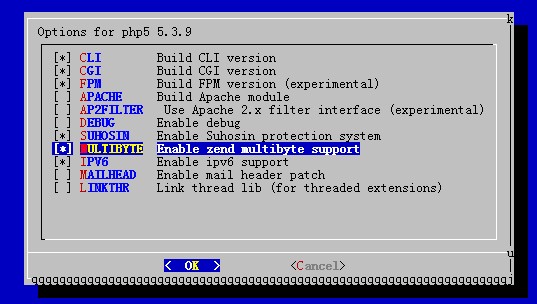
# make install clean
之后安装 PHP5 的扩展库
# cd /usr/ports/lang/php5-extensions
# make config
在对话框中,选择需要的(编译扩展是最耗时间的,至少2-3小时以上,根据需要能少选就少选!以后可以单个安装)
[X] BCMATH bc style precision math functions
[X] BZ2 bzip2 library support
[ ] CALENDAR calendar conversion support
[X] CTYPE ctype functions
[X] CURL CURL support
[ ] DBA dba support
[ ] DBASE dBase library support
[X] DOM DOM support
[ ] EXIF EXIF support
[ ] FILEINFO fileinfo support
[X] FILTER input filter support
[ ] FRIBIDI FriBidi support
[X] FTP FTP support
[X] GD GD library support
[ ] GETTEXT gettext library support
[ ] GMP GNU MP support
[X] HASH HASH Message Digest Framework
[X] ICONV iconv support
[ ] IMAP IMAP support
[ ] INTERBASE Interbase 6 database support (Firebird)
[X] JSON JavaScript Object Serialization support
[ ] LDAP OpenLDAP support
[ ] MBSTRING multibyte string support
[X] MCRYPT Encryption support
[X] MHASH Crypto-hashing support
[ ] MING ming shockwave flash support
[ ] MSSQL MS-SQL database support
[X] MYSQL MySQL database support
[ ] MYSQLI MySQLi database support
[ ] NCURSES ncurses support (CLI only)
[ ] ODBC unixODBC support
[X] OPENSSL OpenSSL support
[ ] PCNTL pcntl support (CLI only)
[X] PCRE Perl Compatible Regular Expression support
[ ] PDF PDFlib support (implies GD)
[X] PDO PHP Data Objects Interface (PDO)
[X] PDO_SQLITE PDO sqlite driver
[X] PDO_MYSQL PDO mysql driver
[ ] PGSQL PostgreSQL database support
[X] POSIX POSIX-like functions
[ ] PSPELL pspell support
[ ] READLINE readline support (CLI only)
[ ] RECODE recode support
[X] SESSION session support
[ ] SHMOP shmop support
[X] SIMPLEXML simplexml support
[ ] SNMP SNMP support
[X] SOAP SOAP support
[X] SOCKETS sockets support
[X] SPL Standard PHP Library
[X] SQLITE sqlite support
[ ] SYBASE_CT Sybase database support
[ ] SYSVMSG System V message support
[ ] SYSVSEM System V semaphore support
[ ] SYSVSHM System V shared memory support
[ ] TIDY TIDY support
[X] TOKENIZER tokenizer support
[ ] WDDX WDDX support (implies XML)
[X] XML XML support
[X] XMLREADER XMLReader support
[ ] XMLRPC XMLRPC-EPI support
[X] XMLWRITER XMLWriter support
[ ] XSL XSL support (Implies DOM)
[ ] YAZ YAZ support (ANSI/NISO Z39.50)
[X] ZIP ZIP support
[X] ZLIB ZLIB support
选择完成后,继续
# make install clean
经过漫长的等待(估计得一个多小时呢),终于完成了编译。启用 PHP-FPM
# echo php_fpm_enable=”YES” >> /etc/rc.conf
# /usr/local/etc/rc.d/php-fpm start
PHP-FPM 的配置文件,在 FreeBSD 下位于 /usr/local/etc/php-fpm.conf,可以自行更改
安装 nginx
nginx 的编译所用的时间相对于前两个东西而言,就快非常多了
# cd /usr/ports/www/nginx
# make install clean
编译选项
[ ] DEBUG Enable nginx debugging
[ ] DEBUGLOG Enable debug log (–with-debug)
[ ] FILE_AIO Enable file aio
[X] IPV6 Enable IPv6
[ ] GOOGLE_PERFTOOLS Enable google perftools module
[X] HTTP_MODULE Enable HTTP module
[ ] HTTP_ADDITION_MODULE Enable http_addition module
[X] HTTP_CACHE_MODULE Enable http_cache module
[ ] HTTP_DAV_MODULE Enable http_webdav module
[ ] HTTP_FLV_MODULE Enable http_flv module
[ ] HTTP_GEOIP_MODULE Enable http_geoip module
[X] HTTP_GZIP_STATIC_MODULE Enable http_gzip_static module
[ ] HTTP_IMAGE_FILTER_MODULE Enable http_image_filter module
[ ] HTTP_PERL_MODULE Enable http_perl module
[ ] HTTP_RANDOM_INDEX_MODULE Enable http_random_index module
[ ] HTTP_REALIP_MODULE Enable http_realip module
[X] HTTP_REWRITE_MODULE Enable http_rewrite module
[ ] HTTP_SECURE_LINK_MODULE Enable http_secure_link module
[X] HTTP_SSL_MODULE Enable http_ssl module
[X] HTTP_STATUS_MODULE Enable http_stub_status module
[ ] HTTP_SUB_MODULE Enable http_sub module
[ ] HTTP_XSLT_MODULE Enable http_xslt module
[ ] MAIL_MODULE Enable IMAP4/POP3/SMTP proxy modul
[ ] MAIL_IMAP_MODULE Enable IMAP4 proxy module
[ ] MAIL_POP3_MODULE Enable POP3 proxy module
[ ] MAIL_SMTP_MODULE Enable SMTP proxy module
[ ] MAIL_SSL_MODULE Enable mail_ssl module
[X] WWW Enable html sample files
[ ] CACHE_PURGE_MODULE 3rd party cache_purge module
[ ] ECHO_MODULE 3rd party echo module
[ ] HEADERS_MORE_MODULE 3rd party headers_more module
[ ] HTTP_ACCEPT_LANGUAGE 3rd party accept_language module
[ ] HTTP_ACCESSKEY_MODULE 3rd party http_accesskey module
[ ] HTTP_AUTH_PAM_MODULE 3rd party http_auth_pam module
[ ] HTTP_AUTH_REQ_MODULE 3rd party http_auth_request module
[ ] HTTP_EVAL_MODULE 3rd party eval module
[ ] HTTP_FANCYINDEX_MODULE 3rd party http_fancyindex module
[ ] HTTP_GUNZIP_FILTER 3rd party http_gunzip_filter modul
[ ] HTTP_MOGILEFS_MODULE 3rd party mogilefs module
[ ] HTTP_MP4_H264_MODULE 3rd party mp4/h264 module
[ ] HTTP_NOTICE_MODULE 3rd party notice module
[ ] HTTP_PUSH_MODULE 3rd party push module
[ ] HTTP_REDIS_MODULE 3rd party http_redis module
[ ] HTTP_RESPONSE_MODULE 3rd party http_response module
[ ] HTTP_UPLOAD_MODULE 3rd party upload module
[ ] HTTP_UPLOAD_PROGRESS 3rd party uploadprogress module
[ ] HTTP_UPSTREAM_FAIR 3rd party upstream fair module
[ ] HTTP_UPSTREAM_HASH 3rd party upstream hash module
[ ] HTTP_UPSTREAM_KEEPALIVE 3rd party upstream keepalive modul
[ ] HTTP_ZIP_MODULE 3rd party http_zip module
[ ] MEMC_MODULE 3rd party memc (memcached) module
[ ] PASSENGER_MODULE 3rd party passenger module
[ ] SLOWFS_CACHE_MODULE 3rd party slowfs_cache module
[ ] SUPERVISORD_MODULE 3rd party supervisord module
[ ] SYSLOG_SUPPORT 3rd party syslog support
[ ] UDPLOG_MODULE 3rd party udplog (syslog) module
编译完成后,启动 nginx
# echo nginx_enable=”YES” >> /etc/rc.conf
这里先不急着 start nginx,因为现在还没有对 PHP 的支持。
# vi /usr/local/etc/nginx/nginx.conf
将如下段落前的 “#” 删除,并且将 html 更改为 /usr/local/www/nginx
location ~ \.php$ {
root /usr/local/www/nginx;
fastcgi_pass 127.0.0.1:9000;
fastcgi_index index.php;
fastcgi_param SCRIPT_FILENAME /scripts$fastcgi_script_name;
include fastcgi_params;
}
结束后,编辑 /usr/local/etc/nginx/fastcgi_params,加入
fastcgi_param SCRIPT_FILENAME $document_root$fastcgi_script_name;
启动 nginx,看看是否已经对 PHP 了
# /usr/local/etc/rc.d/nginx start
# echo “<?php phpinfo() ?>” > /usr/local/www/nginx/info.php
访问 http://yourdomain/info.php,看到 phpinfo 的页面则证明无误。
安装 eAcceletrator
eAcceletrator 可以预编译你的 PHP,这样执行的时候,就会起到加速作用。(下图红色地址部分需要根据自己编译结束后给出的地址修改)
# cd /usr/ports/www/eaccelerator
# make install clean
# echo zend_extension=”/usr/local/lib/php/20060613/eaccelerator.so” >> /usr/local/etc/php.ini
# mkdir /tmp/eaccelerator
# chown www /tmp/eaccelerator
# chmod 0700 /tmp/eaccelerator
# /usr/local/etc/rc.d/php-fpm restart
再刷新刚才的 info.php,看看是不是加入了 eAcceletrator 的支持
安装memcached
cd /usr/ports/databases/memcached
make install clean
cd /usr/ports/databases/pecl-memcache
make install clean
echo “memcached_enable=YES” >> /etc/rc.conf
开启 /usr/local/etc/rc.d/memcached start
下面附上安装过程中会下载的软件(只供大致参考,一般都需要自己下载,可以配置163的镜像源)
/usr/ports/distfiles/xcb-proto-1.6.tar.bz2
/usr/ports/distfiles/varnish-3.0.2.tar.gz
/usr/ports/distfiles/unzip60.tar.gz
/usr/ports/distfiles/tcl8.5.11-src.tar.gz
/usr/ports/distfiles/t1lib-5.1.2.tar.gz
/usr/ports/distfiles/suhosin-patch-5.3.9-0.9.10.patch.gz
/usr/ports/distfiles/sqlite-src-3071000.zip
/usr/ports/distfiles/screen-4.0.3.tar.gz
/usr/ports/distfiles/repcached-2.3.1-1.4.10.patch.gz
/usr/ports/distfiles/redis-2.4.4.tar.gz
/usr/ports/distfiles/php-5.3.9.tar.bz2
/usr/ports/distfiles/pcre-8.21.tar.bz2
/usr/ports/distfiles/pcre-8.20.tar.bz2
/usr/ports/distfiles/openldap-2.4.26.tgz
/usr/ports/distfiles/nss-3.13.1.with.ckbi.1.88.tar.gz
/usr/ports/distfiles/nload-0.7.3.tar.gz
/usr/ports/distfiles/Nginx_upstream_hash-0.3.1.tar.gz
/usr/ports/distfiles/nginx_upstream_fair-20090923.tar.gz
/usr/ports/distfiles/nginx-1.0.11.tar.gz
/usr/ports/distfiles/mysql-5.5.20.tar.gz
/usr/ports/distfiles/memcached-1.4.10.tar.gz
/usr/ports/distfiles/make-3.82.tar.bz2
/usr/ports/distfiles/m4-1.4.16.tar.bz2
/usr/ports/distfiles/libxcb-1.7.tar.bz2
/usr/ports/distfiles/libtool-2.4.tar.gz
/usr/ports/distfiles/libpthread-stubs-0.3.tar.bz2
/usr/ports/distfiles/libpng-1.4.8.tar.xz
/usr/ports/distfiles/libpng-1.4.8-apng.patch.gz
/usr/ports/distfiles/libmcrypt-2.5.8.tar.gz
/usr/ports/distfiles/libiconv-1.13.1.tar.gz
/usr/ports/distfiles/libgpg-error-1.10.tar.bz2
/usr/ports/distfiles/libgcrypt-1.5.0.tar.bz2
/usr/ports/distfiles/libexecinfo-1.1.tar.bz2
/usr/ports/distfiles/libevent-1.4.14b-stable.tar.gz
/usr/ports/distfiles/IO-Tty-1.10.tar.gz
/usr/ports/distfiles/help2man-1.40.5.tar.gz
/usr/ports/distfiles/haproxy-1.4.16.tar.gz
/usr/ports/distfiles/gettext-1.05.tar.gz
/usr/ports/distfiles/gettext-0.18.1.1.tar.gz
/usr/ports/distfiles/freetype-2.4.7.tar.bz2
/usr/ports/distfiles/eaccelerator-0.9.6.1.tar.bz2
/usr/ports/distfiles/cyrus-sasl-2.1.25.tar.gz
/usr/ports/distfiles/curl-7.21.3.tar.bz2
/usr/ports/distfiles/cmake-2.8.7.tar.gz
/usr/ports/distfiles/check-0.9.8.tar.gz
/usr/ports/distfiles/automake-1.11.1.tar.bz2
/usr/ports/distfiles/autoconf-2.68.tar.bz2
/usr/ports/distfiles/agentzh-headers-more-nginx-module-v0.16-0-gde77fd2.tar.gz
/usr/ports/distfiles/xorg
/usr/ports/distfiles/ruby
/usr/ports/distfiles/python
/usr/ports/distfiles/PECL
/usr/ports/distfiles/jpeg8b2
/usr/ports/distfiles/gnome2
最后说一下安装phpMyAdmin
cd /usr/ports/databases/phpmyadmin
make install clean
Alias /phpmyadmin /usr/local/www/phpMyAdmin
修改nginx.conf文件
vi /usr/local/etc/nginx/nginx.conf
在主域名下面插入
location /phpmyadmin/ {
alias /usr/local/www/nginx/phpMyAdmin/;
index index.php index.html index.htm;
}
Location ~ ^/phpmyadmin/(.*\.php)$ {
root /usr/local/www/nginx/phpMyAdmin/;
fastcgi_pass unix:/tmp/php-fpm.sock;
include fastcgi_params;
fastcgi_param SCRIPT_FILENAME /usr/local/www/nginx/phpMyAdmin/$1;
fastcgi_param DOCUMENT_ROOT /usr/local/www/nginx/phpMyAdmin;
}
然后
cd /usr/local/www/phpMyAdmin
mkdir config
chmod 777 config
phpMyAdmin by going to http://hostname/phpmyadmin/setup/index.php in your browser and set at least the following:
做好了一些基本的设置后
cp config/config.inc.php .
rm -rf config
chmod 444 config.inc.php
这样就可以访问phpMyAdmin了
以上参考的网站